


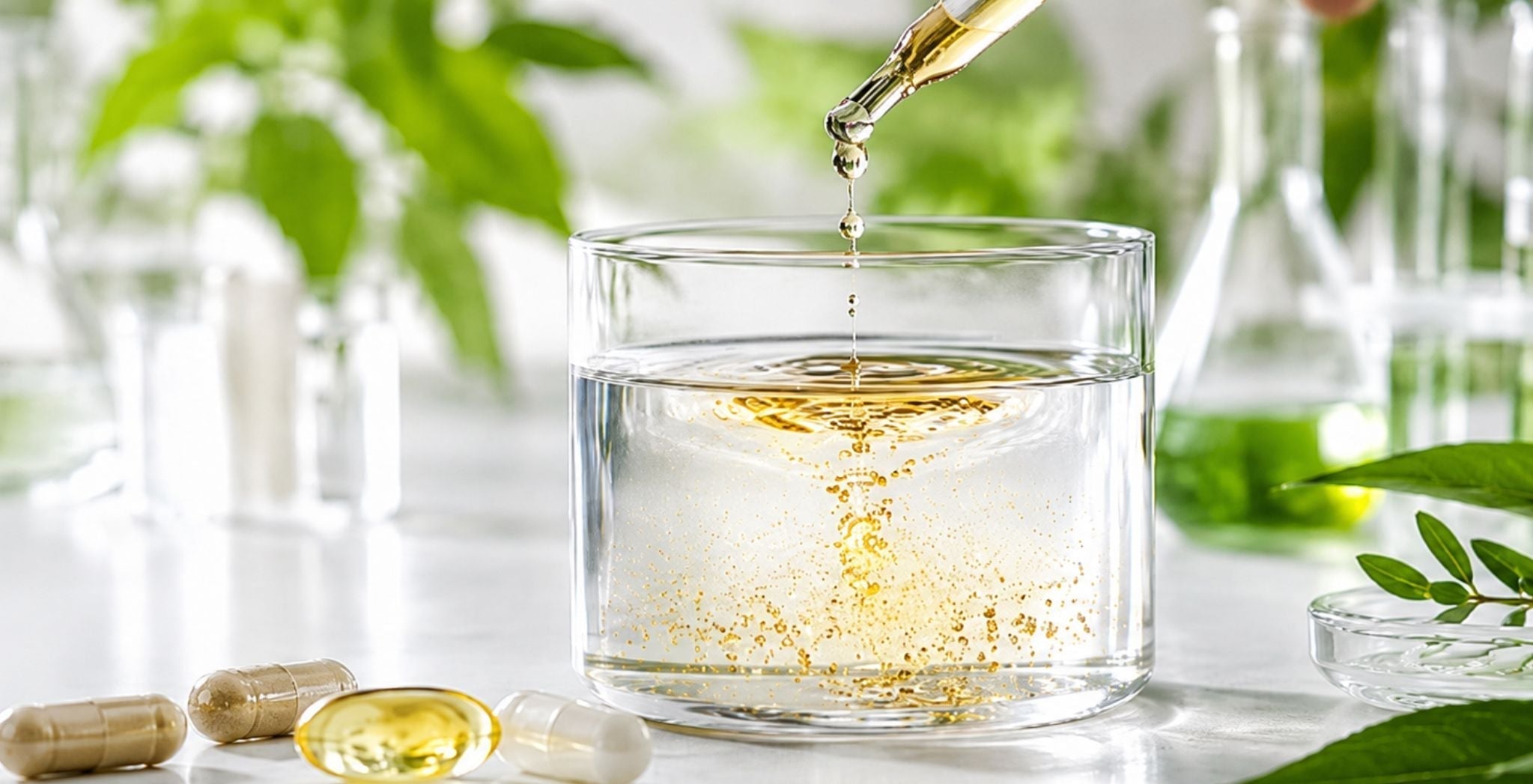
Why Liquid Supplements Are More Bioavailable Than Capsules & Powders
Taking your vitamins shouldn't feel like a waiting game. Every day, millions of people swallow hard pills, capsules, and chalky powders hoping to boost their energy, immunity, and longevity but few stop to ask the one question that actually matters
The delivery format of a supplement plays a far bigger role in its effectiveness than most people realize. While pressed pills have been the industry default for decades, modern nutritional science points toward a more efficient alternative: liquid supplements, prized for their ease of absorption and high bioavailability.
Below, we break down what bioavailability really means, how liquid formats compare to pills and capsules, and when switching to liquid makes the biggest difference.
What Bioavailability Actually Means

Bioavailability refers to the amount or percentage of a nutrient that your body is able to absorb after you consume it. In simple terms, it shows how much of the vitamin, mineral, or active ingredient successfully enters your bloodstream and becomes available for your cells and tissues to use.
To get there, a nutrient has to survive a demanding journey:
- Pass through the highly acidic environment of the stomach
- Move into the small intestine
- Cross the intestinal wall
- Filter through the liver
- Finally enter general circulation
If a nutrient has low bioavailability, a large portion of it never completes this journey it simply passes through the body as waste.
Factors that affect absorption include:
- Age
- Gut health
- Presence of digestive enzymes
- Chemical structure of the vitamin itself
- The physical form of the supplement (the most controllable variable)
When a nutrient is already dissolved in liquid, your body doesn't need to spend energy breaking down solid binders, fillers, or capsule shells. It's ready for immediate processing.
Tincture vs. Pill: Where the Real Difference Lie

Solid pills and tablets
- Made of compacted nutrients combined with binders, stabilizers, and flow polymers
- Require the stomach to physically churn and dissolve them using gastric acid
- Take roughly 20 minutes to over an hour to break down
- Manufacturing heat and pressure can degrade sensitive vitamins before they reach the shelf
Liquid and tincture
- Nutrients are already suspended in a fluid base, ready for absorption.
- No mechanical breakdown required — bypasses the stomach's digestive workload.
- Begins absorbing within minutes rather than waiting for a shell to dissolve.
- Gentler processing helps preserve nutrient integrity and delivers a smoother digestive experience.
Solid pills require time and digestive effort to break down before nutrients become available, while liquids and tinctures are already in an absorbable form, so the body can use them almost immediately with far less digestive strain.
Sublingual Absorption: A Direct Route to the Bloodstream
One of the biggest advantages of liquid formulas is their ability to support sublingual absorption. This means placing the liquid dose under the tongue and holding it there briefly before swallowing.
The area under the tongue is highly absorbent because it contains many tiny blood vessels called capillaries. Since the tissue is thin, certain nutrients in liquid form may pass through this area and enter the bloodstream more dire
Why sublingual absorption matters:
- It may support faster absorption compared to traditional pills or capsules.
- It can help reduce nutrient loss that may happen during digestion.
- It allows part of the formula to absorb before reaching the stomach.
- It may be easier for people who do not like swallowing tablets or capsules.
When a pill or capsule is swallowed, it must first travel through the digestive system. The body then breaks it down in the stomach and intestines before it is processed by the liver.
This process is known as the first-pass effect. During this stage, liver enzymes may break down a portion of the active compound before it fully reaches the bloodstream.
With sublingual delivery, some of the formula may absorb directly through the tissue under the tongue. This can help preserve more of the nutrient in its active form and make it more available for the body to use.
In simple terms, liquid sublingual formulas may offer:
- Better absorption support
- Quicker nutrient availability
- Less dependence on digestion
- A convenient alternative to pills
- Easier daily use for many people
This makes liquid formulas a practical option for those looking for a supplement format that is simple, efficient, and easy to take.
When Liquid Supplements Make the Most Sense

-
Significant nutrient deficiencies :
When levels of nutrients like iron or Vitamin D drop critically low, waiting on slow-dissolving pills isn't ideal. Liquids allow these nutrients to enter the bloodstream faster, which can help support recovery during periods of deficiency.
-
Athletic recovery:
After intense training or competition, the body is in urgent need of nutrients to repair muscle tissue and restore energy stores. Because liquids are absorbed quickly, they can deliver this support to muscles and cells sooner than a slow-digesting capsule would.
-
Older adults:
As the body ages, stomach acid production naturally declines, making it harder to fully break down solid pills and tablets. This can leave a large portion of the nutrients inside a pill unused. Liquids remove this barrier entirely, since there's no solid shell or tablet to dissolve in the first place.
-
Compromised gut health:
Individuals dealing with sensitive digestion, leaky gut, or malabsorption disorders often struggle to extract nutrients from solid supplements. Because liquids require little to no digestive breakdown, they tend to be gentler on the gut and easier for these individuals to tolerate and absorb.
Conclusion
A supplement is only useful when the body can properly absorb and benefit from it. Liquid formulas can make this process easier by allowing nutrients to become available more quickly and with less digestive effort than many traditional pills or capsules. For people who want a simple and practical way to support their daily wellness routine, liquid supplements can be a helpful option when chosen carefully and used consistently.
Frequently Asked Qusetions
Q1. Do liquid supplements work better?
Yes, liquid supplements often provide faster absorption and higher bioavailability compared to pills and powders, delivering nutrients more efficiently to the body.
Q2. What supplements are good for myalgic encephalomyelitis?
Liquid supplements with immune-supporting vitamins, minerals, and antioxidants may help support energy and wellness. Always consult a healthcare provider for personalized recommendations.
Q3. What is the best liquid supplement?
The best liquid supplement depends on your health goals and nutrient needs. Look for organic, high-quality, and trusted brands to ensure safety and efficacy.
Q4. What vitamins are good for numbness?
B-complex vitamins, especially B12, are often recommended for supporting nerve health. Liquid forms may improve absorption in individuals with digestive concerns.
Q5. Where should you buy organic and trusted liquid supplements?
You should always buy from trusted and authorized sellers. Brands like Boosted Botanix offer organic, lab-tested liquid supplements with safety, quality, and reliable customer service.
Read more

If you are exploring the world of adult botanical products, you have likely run into two terms very often: kratom and 7-hydroxymitragynine. For anyone just starting out, it is incredibly easy to co...
Kratom liquid is a liquid-based product made from kratom leaves or extracts. It is available in different forms, including liquid extracts, tinctures, teas, and ready-to-use shots. The strength, in...
